I’m a Web fanatic, I admit. But you probably already knew that… My work environment has been completely web based for years now. The same applies to my music. Like many people, I used to download music from Kazaa
or eMule
(Yeah, I know some of you still do). Most of the time now, I listen to music on the web and don’t have any need to download it. My laptop benefits the most from this inclination since it’s not weighed down by music files, thus saving me tons of space and virus headaches (you eMule users know what I’m talking about). Anyhow, if I do choose to download music, I can always do it over at iTunes or my favorite place in the web: Jamendo
.
Music plays a large role in our lives. Since the web now plays an even bigger part, combining the two together has become unavoidable. The greatest thing about this powerful duo is that you don’t need to spend a lot of time searching for music you like — just use this nifty guide list and you’ll find just about everything you need to enjoy hours of good music. The sound quality changes from service to service, but overall, it’s good enough for regular web usage.
Please note that this is a list of services that you can use over the net without the need to download anything to your computer. This is why I’m not listing any P2P software: i.e., Spotify
, as well the fact that most of us can’t really test it or use it for all that matter. This is also only the first half of this guide; part two will include more web music players (including MySpace Music
, Streamzy, and others) as well as music search engines and services that make it easy to share songs on Twitter and other social sites.
Music Recommendations:
Pandora
is a service that can be used only in a specific locale, this one being within the U.S. Luckily, I had the chance to test the service when it was first released and became available to everyone. Launched way back in July 2005, the project had been in the initial testing phases for five years prior to launch date. Pandora recommends music to you by matching similar musical attributes. All you really need to do is choose an artist or a band you like, and Pandora will do the rest. Pandora delivers high quality 128Kbps audio streams, offering recommendations similar to the artists you have chosen. Pandora’s player looks like a radio, you can open up to 100 stations and navigate through them quickly. Registering for Pandora will provide you with a free account (advertising-supported). Free Pandora accounts will play up to 40 hours of music for free per month, you also have the option to pay 99 cents for unlimited listening hours for the rest of that month, or pay $36 to upgrade Pandora for one year. If you want to download music from Pandora, you can do it through iTunes or Amazon. You can see our past Pandora coverage here.
With almost 3 million unique visitors a day, Last.fm
is one of the most powerful social music communities on the Web today. Like Pandora, the service allows you to enjoy music that you like, but unlike Pandora, Last.fm analyses what you and your friends listen to and like, and then suggests more music based on that analysis. When you recommend music to a friend or you tag it, or you write about it, or simply just listen to it – you shift the song’s importance on the site, and will in turn get recommended to more people. Based on the music you’ve already listened to, Last.fm will recommend new music you might like, as well as suggest other users with a similar music taste to yours, which you might be interested in friending, and you can also easily communicate with them. If you live outside the U.S., U.K. or Germany, you can listen with a free 30-track trial or subscribe for a low price of $3/month for unlimited radio streaming. (Launched in 2002!)
is how BlogMusik, looked in 2006, and this
is how Deezer
(formerly BlogMusik) looks today – pretty impressive change, don’t you think? The French-based service is one of the largest and happens to also be a very successful music recommendation search engine. Once registered here, you can create your personal profile and reach the Deezer community. You can create playlists, send messages to your contacts, leave comments, add artists and albums to your favorites, and more. But here’s what I like the most – The SmartRadio, which is an intelligent radio that automatically generates 3 hours(!) of continuous listening based on one artist – completely free. Priceless! You can see our past coverage of Deezer here.
I think the first Adobe AIR application that I ever tried was Finetune
. Finetune provides you with the most interesting new playlists of related music from your choice of artists. Besides the site’s community where you can browse, listen to music, create a profile, connect with other users and more, Finefune also has some cool feautures to complete their suite, and each tool gives you an extraordinary music experience. Take for example the Finetune Wii project
(which can be played also over the web), it’s a great sight and sound for the eyes and ears. Just enter an artist’s name and Finetune will create a playlist with similar music that will play for hours. Best of all it’s free, and you also get an iPhone
, Facebook and a Desktop app that all sync with your music playlist, no matter where you play it from. You can see our past coverage of FineTune here.
Also worth mentioning in this same topic group are, of course: Ilike.com
(acquired by Myspace), and music.strands.tv
Independent Music:
Amie Street
is a home for musicians. The service allows music fans to discover new and independent music. Visitors at the site can search for new music based on genre, region, or recommendations. Fans can also search for music according to its price - Amie Street is actually the only marketplace where listeners determine the price of the music. How does it work? Every song is originally priced free or very inexpensive and increases in price, up to 98 cents, as more and more users purchase it. Musicians then get 70% of the revenue from each sale. Additionally, Amie Street matches you with music that you might like, for example: I couldn’t locate Coldplay on the site, but I got more than 70 results that sound similar to the band. Obviously, this exposes me to music that I’ve never heard before, which is always a welcomed experience. You can see our past coverage of Amie Street here.
Why is Jamendo
one of my favorite music services? It offers the largest catalog of music under Creative Commons licenses – worldwide. And, not only are all of the albums free to download, there’s also a large chance you won’t know any of the artists. If you already have an open mind about music, surely it won’t stop you from listening to some new albums, right? The best way to find music at this site is to search by the genre tags. Found something that you like? You can review, comment, rate, share and as I’ve said download it for free. The service is available in seven languages, and has an iPhone app
that you can download for free. Business model? Yes they have
one too.
is by far the best looking music application there is today. It offers a great interface, a great user-experience and above these all, great music! SoundCloud lets music professionals receive, send and distribute their music. The service allows professionals (and non-professionals) to exchange, and follow music and musicians at the site. It’s a full community where people can easily communicate with each other based on shared tastes, but it is also a place where musicians can store and showcase their music using high quality standards. With the free account, you can only upload 5 tracks maximum per month, but if you are an industry fanatic and you find this plan to be somewhat lacking, you can check the pro page
for packages that are more suitable to your needs. See our past coverage here.
allows artists to upload their songs and lets thousands of listeners decide whether they like it or not. The most popular songs hit the front page. Think about it as a Digg for music, the more people heart a song, the higher it goes. The site connects musicians and fans, giving them all the tools to communicate with each other. For artists, it’s good place to promote their work. For anyone else, it’s a wonderful place to discover and support new music.
Create & Listen to Playlist:
I’ve never been very much of a Project Playlist
fan, but I have to say it’s a good service. Ultimately, it’s a community based on playlists. You don’t have to register to be able to listen to the music, but once you do, you can start building your playlist and enjoy more features such as the Playlist IM, which is a chat system similar to Facebook where you can connect your ‘playlist’ friends or even friends from AIM, Facebook, Yahoo Messenger, etc. What else? You can write blog entries, upload photos, privately connect with other members, browse thousands of other music playlists, comment, share, and much more. My guess is that people use this site mostly to share their playlist on their blog/site or social network. Playlist allows you to grab a playlist code and embed it anywhere you want. One thing that bugs me though is that the member’s search feature is missing. Today, when everything is so connected to your identity, this is a must have feature. On the other hand, I was impressed to see they saved my playlist
from 2006…
allows you to create personalize playlist and share it in the Jiwa.fm community or with friends & family. As a member, you are able to share, exchange, and explore music. You can also expand your tastes with the SmartRadio tool. I found this service to be unique in a way because no matter what you are doing at the site, it won’t prevent you from listening to your playlist, it just plays in the background. Amazingly, when you click on an artist from within a mixed artists playlist, it will automatically create
an album playlist of that artist. You might find the site to be a bit cluttered at first time, but once you get it, it works like a charm – highly recommended.
At Jogli
, you don’t really need to create a playlist – they create it for you. Think about it as a giant web-based CD store where you can search for an artist, see all of his/her albums, and then listen to them exactly as listed in original CD Let’s take Michael Jackson for example: Here
you can find all his discography, and listen to his CDs one by one. Clicking on the button ‘Play Radio’ will open a radio station generated from music you might like from similar artists. As a registered member, you are able to save playlists, write reviews, and more. You can also import your playlists to Last.fm or iTunes to make it a video playlist. Check out our past coverage of Jogli here.
would have been better and easier if they allowed you to search for Youtube videos on their site to create a playlist. But no, you have to supply them with a Youtube URL, which means, you’ll have to go directly to Youtube, search for a song, then copy-paste that song URL back into MixTube. Thus, I found it to be frustrating. But looking at the bright side, you can always search for someone else’s playlist, and save yourself time and agony. One word about the Youtube music integration – lots of services use it, but unfortunately, it doesn’t offer you much control of your playlist, and what plays today, may not play tomorrow..
is another great music store/playlist maker that we’ve covered extensively since the site relaunched last year. It allows users to listen to any song they want one time. If you want to listen to a song more than that, you buy a 10 cent ‘web song’ that lets you stream the song from the cloud as many times as you want (you can also purchase a full download of the song as you would from iTunes or Amazon). The site has a great integrated music player and a variety of pre-made playlists built by other users.
Worth mentioning: Imeem
, and Maestro.fm
Music Visualization:
There’s no doubt in my mind that Musicovery
has a strong following of avid users. The site is an interactive and personalized webradio enabling its users to generate in a few clicks a musical program adapted to the various listening situations and their preferences. Their unique mood matrix proposes a relationship between music and mood in an ergonomic and attractive manner. I’ve submitted this item about the service to Digg
in 2006 and it’s good to see the site still works . But things have changed. You have limited navigation if you’re not a pro user ($15/3 months or $48/12 months), but once you are – the sky is the limit. In any case, this service will blow you away.
is perhaps just a mashup site, but it’s a good one! CitySounds.fm collects music from SoundCloud and pictures from Flickr to create a wonderful music experience from a single page. You can listen to the latest music from cities all around the world. At the top are the most active cities and the list is constantly changing as new music is being created.
Web-Radio:
Very similar to Last.fm in concept, Jango
allows you to create your own custom radio stations and share them with friends. Just type in what you want to hear – and your station will immediately play the music you want along with similar favorites of other Jango users who share your tastes. You can customize your stations further by adding more artists and rating songs. Each artist get a page, containing the web-radio, the music playlist, biographies, events list, comments from members at the site, and fan list for easy communication. The service claims to be legal and says it pays royalties due to all labels/artists every time a song is played. Moreover, Jango runs a program called Jango Airplay. This program gives emerging artists an unprecedented opportunity to be proactively exposed to the millions of visitors at the site. See our past coverage of Jango here.
is an efficient way to locate radio stations in your area or around the globe. You can search stations by geography, genre, band, language or tags. You can listen without signing up, or you can log in and create your personal dashboard with favorite stations that you can then listen to on a daily basis. We mostly hear radio on the go, but now you can easily track your favorite radio stations on the web. All the radio stations are public so you aren’t asked to pay anything to use the site.
OK, TheRadio
is also one of my favorites because of its simplicity. Entering an artist or a genre gets you custom channel, but if you go over the channel listing, you will find much more interesting suggestions. I don’t know about you but I actually like when someone else picks the music as long is it in the range of my request. Anyway, TheRadio does a great job on finding music that I like – it simply works.
fits in the Recommendation list as well as this category. The service lets you experience music in a fours different ways: by Stations, Artist, Mood, and Personal. The Stations area is pretty limited if you don’t have a pro account, but you can still get the feel of it. In the Artist zone, you enter your favorite name and choose from a variety stations suggested. The coolest way is the Mode area, which plays music based on your chosen mode. These stations are created by music experts, says Aupeo. The Personal station streams music based on your music behavior at the site. Overall, very intensive and powerful!
Worth mentioning: Tun3r
That’s it for Part 1 of this music guide. If you have any other suggestions related to these groups, you are more than welcome to add them in the comments. In the next part of this post, I’ll offer the best options for Music search engines, Music web-players, Twitter-Music craziness, and more. Stay tuned!
Image by RossinaBossioB
on Flickr.
Website: go2web20.net Birthplace: Israel Companies: Go2Web20 Orli Yakuel is a Web2.0 analyst and the editor of Go2web20 - A personal blog about Web2.0 technology.
She’s also a co-founder at Go2web20.net - which is a directory for Web2.0 applications. (in association with Eyal Shahar) Learn More
Information provided by CrunchBase
Sunday, September 27, 2009
From TechCrunch. Your Guide To Music On The Web – Part #1


Fron GigaOm. Time for Digital Music to Get a Reality Check
Time for Digital Music to Get a Reality Check
By Paul Bonanos | Saturday, September 26, 2009 | 11:00 AM PT | 0 comments
It’s been a busy September for the digital music business. Steve Jobs reappeared onstage to introduce the iTunes LP format and a series of new iPods. Anticipation grew around European streaming music service Spotify, which is due to arrive on U.S. shores in the coming months. And a series of mobile music applications that compete indirectly with the iPod were approved by the very company that makes the device. So it seems like a good time to assess the chances these key music models that have received so much attention and investment have of surviving.
Selling music online: Apple still owns more than two-thirds of this market, with largest challenger Amazon.com still only accounting for single-digit market share. Interest in owning music could decline in some circles as streaming services improve, especially in the mobile sphere, but any erosion is likely to be slow, and physical media customers are still moving online, too. Selling MP3s is a low-margin business, but as part of a larger one — selling gadgets, as Apple does, or barbecue grills, as Amazon does — it’s worth staying in the game. Anyone else, though, would be crazy to enter this market and expect big returns. As for the price of music, expect increased flexibility, especially for developing artists. Prognosis: Stable, for now.
Free on-demand streaming: Thanks to a user interface that echoes Apple’s, much-hyped Spotify is the purported game-changer in what’s shaping up to be a three-horse race alongside Imeem and MySpace Music, with user interface emerging as the most significant factor in determining a winner. (Google’s YouTube is running a different race, but on the same track.) Major labels have stakes in all three providers, and have generally been disappointed with the returns thus far, in part due to the soft ad market. Some or all may reach profitability amid reduced expectations, but none is likely to produce a strong exit for stakeholders. Prognosis: It’ll pull through.
Paid subscriptions: The all-you-can-eat music rental service is getting a shot of adrenaline by going mobile. The two leaders, RealNetworks’ Rhapsody and Best Buy-owned Napster, have had difficulty reaching even a million customers despite several years of trying, and the price of music rental is falling, but the promise of any song, anytime, anywhere via mobile apps is leading to a make-or-break moment for these services, especially with Spotify entering the fray by applying the “freemium” model. If ubiquitous music access doesn’t revive the subscription service, nothing will. Apple, for one, has conspicuously stayed out of it so far. Prognosis: Requires experimental treatments.
Internet radio: A new royalty rate agreement this summer stabilized market leader Pandora and its ilk for the next few years. Pandora’s own service is beloved enough, but its stakeholders may never get the payoff they’ve been waiting for, and what happens after 2015 is anyone’s guess. By comparison, rival Last.fm’s exit strategy — getting acquired two years ago — was the best one. Prognosis: “I’m not dead…I’m getting better!“
Legacy businesses: Believe it or not, CD sales are still outpacing digital downloads, although the twain shall finally meet next year. The Beatles, for one, are doing all right selling physical product to diehards. The independent music business, in particular, is even enjoying an uptick of interest in vinyl. Prognosis: The old boy’s got some life in him yet.
Piracy: With a 95 percent market share for downloaded music, this is as close to a sure thing as I can imagine. Yeah, growth in free streaming might reduce piracy, and people are going to jail for leaking music early. But if anything, music piracy may be getting easier. Prognosis: Thriving, with a chance for eternal life.
Saturday, September 26, 2009
Held Hostage by CPM-Based Media Buying? A TechCrunc Post Proposes: Let’s Kill The CPM.
Editor’s note: This guest post is written by Shelby Bonnie
, the CEO of Whiskey Media
. He co-founded CNET in 1993 and was the Chairman and CEO from 2000 to 2006. He served as Chairman of the IAB from 2001 to 2003. Whiskey Media is a content platform with three sites, giantbomb.com
, and animevice.com
lots more to come.
OK, Advertising Week just ended
… does anyone else feel like the online advertising industry is the orchestra, playing on while the Titanic is sinking?
We have a problem, folks. And I, for one, think we should start to fix it by killing off the CPM
, once and for all.
I have been in the Internet media space for 16 years and will start by stating the obvious: The CPM has done more to stunt innovation and drag down quality products than any single thing on the Internet. Maybe it works in other mediums, but it sure as hell doesn’t work on the Internet. Having been both a small and big publisher (now small again), it’s been my experience that the collective focus on CPMs and counting eyeballs by marketers, agencies, and publishers has led to a whole mess of unintended consequences that have produced a series of “solutions” that work for none of those parties. And perhaps more importantly, it’s been terrible for users.
All campaigns start with the best of intentions: “let’s do something creative, engaging, and unique!” But unless someone really senior from the agency or client side intervenes, the road for a campaign always leads to the media buyer and the dreaded spreadsheet, where the two most important columns are impressions and cost. Ironically, there’s usually some good stuff in campaigns, but they are thrown in for free as “value adds.” At some point, publishers decide that if all clients care about is impressions, then OK, we’ll give them impressions. The output is an industry that overproduces shallow, superficial, commoditized impressions. Why do we have so many bad sites that republish the same junky content–content that’s often made by machines or $1-per-post contractors? Why do sites intentionally try to get us to turn lots of pages with tons of top 10 lists,
or single-paragraph summaries of someone else’s story
?
In 2002, my first full year as Chairman of the IAB, we made a decision as an industry to kill the original small banner (468×60). Though it was the only unit that many of our partners accepted, if we didn’t kill it, the industry would have had a very difficult time moving past it. We had to be bold and take some risk, but at that time we ushered in the move towards larger ad units, a move that all agree was a big improvement. We are at a similar point today. The focus on CPM is causing a bunch of behavior that is bad for publishers, marketers, and users. Only by killing it do we have the opportunity to invent our new future.
Why is the CPM such a problem?
- You always get what you pay for. I believe in basic economics. If you pay for impressions, you get impressions. Is that, in the end, what marketers really want? How about engagement? How about impact? How about actually selling product? A glut of impressions has helped no one.
- All impressions are not created equally. There’s a big difference between seeing an ad on a page of content that contains one uninteresting paragraph and twelve ads, and seeing a single ad on a page that is relevant to the ad and covers a topic for which the user is highly passionate and engaged. The differences between social network and content inventory is another example–how do you put those items on the same spreadsheet?
- There is no natural constraint . TV, print, and radio can only put so many ads within their product. But on the Internet, that is not the case. We can continually increase the number of ads per page or manipulate users’ behavior to goose our impression numbers. Can’t you see some publisher saying “if they just want impressions, why don’t we go from four ads on a page to eight” or “couldn’t we turn a new ad every time someone loaded up a new e-mail?”
- It doesn’t mean anything anymore. With such a glut of impressions from all media and the number of impressions with which people are bombarded with every day, it just doesn’t matter anymore. It’s an arcane notion that’s a holdover from a time when there wasn’t as much media. As I said, TV, radio, and print had natural constraints and there was a lot less of it. So just seeing an ad was, by definition, unique and impactful. Those days are no longer.
- Senior marketers get it, but there is a whole infrastructure built around the CPM. The process is built up around how ads are bought and sold, based around a media plan, and asked for in RFPs. All the good, creative thoughts get boiled down into spreadsheets, that are for the most part owned by folks that are not that far removed from their last college class. Even senior folks have to try to fight their own system to keep the ideas that they like.
- This is not a win for marketers. In a world of over-produced impressions, even great work by marketers is ignored at best and more commonly not even seen.
- The ultimate losers are the users. They get a lot of bad content and bad ads. They are literally overrun by ads all day.
What will a new solution need?
- Simple. In the end, I realize that to make the business of marketing work it can’t all be art. You have to have a way to create a streamlined process. Everyone wants and needs a way to compare campaigns and metrics to determine success. Simplicity can lead to scalability, which allows for more efficiency for publishers, agencies, and marketers. Having said that, the simplicity we now have has led to a model that doesn’t work.
- The metrics should be more closely aligned with what you want. Whatever you pay for is what publishers will start mass producing. If you want engagement, pay for engagement. It is unclear whether there is one metric or many. A starting point might be to start with uniques, actions (like sharing, contributing, and engaging), and time.
What about the CPA or CPC?
- CPA and CPC have their appropriate time and place, but let’s recognize that those situations are limited. Yes, they work great when people know exactly what they are looking for, but how do you convince them to buy something they don’t know they need? Pure click performance just emphasizes the status quo of what I already know and already buy. Yes, it’s an action… but so is a video view, a wiki contribution, a contest sign up, a tweet about a product, and so on. We also know that a singular focus on these items would create as crazy a set of unintended consequences as we’re currently dealing with today.
Where do we start?
- First, just stop using the CPM. Yes, it will break every model and process that the industry holds dear, but we need to get rid of the crutch. The ensuing turmoil will bring creative thinking, new ideas, and entrepreneurial passion.
- Let it be a movement, not a task force or sub-committee. Create room and dollars for entrepreneurs to experiment and try new things. They all might not work, but we will collectively learn. A bunch of task forces by industry associations will only make it worse.
- Think open source. This should not be proprietary or an individual company’s technology, it needs to be an effort on everyone’s part to do this together with the benefit accruing to us all.
- Realize that we all share a common need to fix this. The fight is with the system, not each other.
I certainly don’t have all the answers myself, but as a veteran of this space and someone who deeply cares about the medium, it is about time we all make a concerted effort to change our direction. I would love to hear your thoughts (shelbyb [at] whiskeymedia [dot] com).
Photo credit: Flickr/SuperFantastic
Website: whiskeymedia.com Companies: Whiskey Media, CNET Networks Shelby Bonnie is CEO of Whiskey Media, an online publisher that builds topical Websites, including giantbomb.com, comicvine.com and animevice.com.
Prior to Whiskey Media, he co-founded… Learn More
Website: whiskeymedia.com Location: Sausalito, California, United States Founded: October 1, 2007 Whiskey Media develops topical websites that are equal parts editorial and community. To date, they have built sites about video games,… Learn More
Information provided by CrunchBase


From PBS / Media Shift. The Great Debate on Micropayments and Paid Content

Thank you.
Carpe Diem! BING KIMPO9/F IBM Plaza
Eastwood Cyberpark
E. Rodriguez Jr. Avenue, Bagumbayan
Quezon City 1110
Philippines
+63.918.9241448 / +63.9175660524 (Mobile)
+63.2.7037211 (Landline)
bing@bingkimpo.com (Email)
bingkimpo (Skype, Yahoo! Messenger, Windows Live Messenger, GoogleTalk, Facebook, Twitter)
www.bingkimpo.com
Friday, September 25, 2009
RP gets grant to promote e-commerce - INQUIRER.net, Philippine News for Filipinos
Peso Dollar End -->
ARTICLE SERVICES INQUIRER ---> Reprint this article
Print this article
Send as an e-mail
Send Feedback
Post a comment
RELATED STORIES INQUIRER --->


http://bizlinq.net/">http://bizlinq.net/">Quaint Life Enterprises by Enchanting Blooms
http://bizlinq.net/">Cell No.: (0917)540.4455
Tel No.: 716.6007
Contact Person: Theresa Mora Uyhttp://bizlinq.net/">http://bizlinq.net/">Aquabest Franchising
http://bizlinq.net/">Contact Person: Lyn Cordon
Tel. No.: 371-0478 / 332-2222 Loc. 115-116
Email Add: inquiry@aquabest.com.ph
RP gets grant to promote e-commerce
INQUIRER.net
First Posted 20:02:00 09/24/2009Filed Under: Technology (general), Internet
Most Read-->Other Most Read Stories xTechnology
- RP gets grant to promote e-commerce
- Teachers, police to help study poll system
- Vilma is like Sarah Palin ‘but with substance’
- A millionaire at 28 thru e-commerce
- As election nears, DICT campaign continues
- RP declines in IT competitiveness study
- Hackers exploit “Hayden” sex videos
- Google chief eyes new acquisitions
- Roxas vows to wage war on ‘SOPs’
- Son offers sexy photos of mom on Internet
Technology Most Read RSS
MANILA, Philippines – The Philippines has been chosen as one of the first recipients of the Mobile Money for the Unbanked (MMU) Fund by the GSM Association, an international organization of telecommunications operators.
The grant aims to create an electronic and mobile money scheme in areas with a population that does not have bank accounts.
The MMU Fund also considers using applications developed by operators in different countries.
In a statement, the GSMA said the MMU Fund should help the organization reach its goal of having 20 million “unbanked” users worldwide to start using e-commerce for their payment schemes.
The MMU Fund is also supported by a $12.5 million grant from the Bill and Melinda Gates Foundation
In the Philippines, telecommunications firm Smart Communications will be one of the four initial recipients of the MMU Fund.
Smart will use the funds to expand its Island Activations Program, which provides microfinance institutions with systems that allow for mobile payment and mobile banking.
The Island Activation Program was started in 2008 in Pollilo Island, Quezon.
The other three recipients of the MMU Fund are Axis in Indonesia, Oi in Brazil, and Roshan in Afghanistan. Alexander Villafania


From The Daily Beast. Is Malcolm Gladwell a LOVE GURU?
Bernard Weil, Toronto Star / Newscom In his books, bestselling author Malcolm Gladwell has dissected many inspirational underdog victories, but his own triumph over the opposite sex could well be the most inspirational of all.
Eight years ago, on a balmy night in New York's West Village, a darkly beautiful history grad was having a date with a 38-year-old writer. He was a little goofy looking and gesticulated a lot, but he was sweet and had theories about a million things, especially her. He was particularly interested in what made her special. When she revealed a passion for acting, he had a theory about that, too, and how to make it more special.
They drank some wine. They talked some more. He fluttered his long, slender fingers. He seemed so comfortable in his own skin, so authentic. He had this eerie feline self-assurance, and it was hypnotic. Forty minutes later, they were back at his place.
In his books The Tipping Point, Blink, and Outliers, bestselling author Malcolm Gladwell has dissected many inspirational underdog victories, but his own triumph over the opposite sex could well be the most inspirational of all. Since moving to New York in 1996, he’s cast his net wide and deep to amass a staggering tally of conquests. There’s been the poetess, the psychotherapist, the photographer, the filmmaker, the fact checker, the writer at The New Yorker, the bisexual literary siren....
The tall blonde he took to Bar Blanc last December was so smoking hot, an eyewitness wrote that Gladwell “made all the guys in the restaurant want to write their own New York Times bestsellers!”
And these are seriously attractive women, too. The tall blonde he took to Bar Blanc last December was so smoking hot, an eyewitness wrote that Gladwell “made all the guys in the restaurant want to write their own New York Times bestsellers! It was...like the high-school geek landing the prom queen—so wrong, yet so right. “
Gladwell the master boulevardier has in effect become his own outlier, a statistical anomaly too great to ignore. So I set off—in the true Gladwellian spirit of pragmatic inquiry—to examine his amazing transformation from dorky scrivener to epic ladies man.
Growing up in rural Canada, things were not promising for the young penman. Despite loving parents, he was the classic loner who preferred toys to socializing. “I was not a joiner,” he wrote in a family memoir. At Trinity College at the University of Toronto, he was even more socially maladroit. He assumed the pose of young Republican and put a poster of Ronald Reagan on his wall. His friends were no help, either. “We were too nerdy to party,” he has said.
Nine years at The Washington Post did wonders for his professional confidence, and he discovered the social side of reporting. But romantically, there was still no indication of the jungle-maned Casanova to come. “He was kind of nondescript,” recalls a former co-worker who turned down a dinner date.
Then, in 1996, to use a favored Gladwellism, came the moment that changed everything. In a seismic collision to rival Bill Gates discovering his first computer, or Wayne Gretzky getting his first hockey stick, Gladwell moved to The New Yorker.
The magazine’s tony mix of intellect and bohemian chic was the perfect home for Gladwell’s innate quirkiness. His obsessive theorizing was no longer weird. It was intriguing and exotic. Out went the sleeveless V-necks; in came the Nikes, jeans, and artfully untucked shirts. He got a pad in Tribeca and alighted on his signature prop—the mad-professor afro. The prototype was Albert Einstein, who was no slouch with women himself. But Gladwell modernized the look with a shoulder bag and turned himself into a local fixture, toiling over his laptop in cafes and restaurants. He went to book launches, magazine parties, and nightclubs, and enjoyed park-bench picnics.
He became a published author and hit the publicity circuit, which gave him the necessary practice hours to hone his knack for yarn-spinning.
On stage, he can keep a packed auditorium totally spellbound with his dilatory talks that weave together Fleetwood Mac, Fermat’s Theorem, and contemporary design. Over a health-food meal for two, it’s even more seductive. Friends have a phrase for the bachelor maestro’s pixie-dust magic: They call it having “Malcolm powder” sprinkled in your eyes.
But stimulating conversation, however silky, only gets you so far. In any seduction, there is the moment on the sofa or doorstep when subtext becomes text, when intentions have to become clear and a decision made, one way or the other—the Schtupping Point.
There is a range of opinion among Malcolm’s seraglio on how the master handled this pivotal moment.
“It was seamless. One minute you’re walking along; the next you’re arm in arm.”
“Hmmm. How long ago was that? It wasn’t some slick move, if that’s what you mean. Just very normal, very sweet. He’s a runner, you know. Trim as a bird.”
Clearly, it was time to talk directly to the great man himself. I was excited to share my discovery with Gladwell that a French psychology professor, Nicolas Gueguen, had conducted experiments in the area of seduction, specifically the art of making the first move. Gueguen found that a light touch on the arm when asking for a phone number gave men a 9 percent higher success rate than an approach with no physical contact. When asking for a dance, the success rate was 22 percent higher. Surely, I thought, this same principle could be applied even more effectively to the pivotal sofa moment.
I tracked down Gladwell on his cellphone, amid the hum of coffeehouse chatter, and outlined my thesis. He was very polite and completely mortified. “This is ridiculous. Why would I want to talk about such a thing?”
Discretion, it goes without saying, is the cornerstone of long-term success in the amatory arts. But I did think some mild theorizing on a beloved topic would prove irresistible to Americans’ alpha mind. I wove together Gueguen’s findings, the rise of the literary rock star, and the importance of iconic hair all in one sentence, and still I hit the wall.
“This is utterly ridiculous. I mean, I don’t know you. How would you know such things?”
I didn’t panic or give up. Like any good outlier, I simply switched to the full court press.
“So, Malcolm, what can you say about the importance of context for any aspiring ladies’ man? How tough is it, for example, to engineer romance wearing a knitted tie in a hard-nosed newsroom?”
As he would put it, this was my Disqualifying Statement, and not just a mild one, either.
“I write books. I’m a private person.”
I tried to say his success with women was a tribute to the fact that he embodied his own principles for late bloomers (10,000 hours of practice minimum!); that he gave hope to lovelorn dweebs everywhere. But it was too much, too late.
”No, no—I don’t think I want to participate in this at all,” said Gladwell decisively, before signing off with his trademark upbeat ending: “But good luck with it!”
I now realize that I should have trusted my initial gut instinct and invited him for help. I tried to impress him, you see, when I should have just been sincere. In effect, what I did was lunge and force the issue, thereby ruining the mood. And that, in a nutshell, is the difference between the novice and the grand master.
Sean Macaulay was the L.A. movie critic for The London Times from 1999 to 2007. He has also written for Punch, British GQ, and The Mail on Sunday. He was most recently creative consultant on the award-winning documentary Anvil! The Story of Anvil.
For inquiries, please contact The Daily Beast at editorial@thedailybeast.com.
A great take on one of my favorite authors. Thank you, Sean Macaulay of The Daily Beast.
A Clip-and-Save Renaissance as More Consumers Use Coupons
Heather Hernandez walked into a supermarket with a stack of coupons last month and walked out with $160 worth of groceries, for which she paid $30.
Skip to next paragraph
Fred R. Conrad/The New York TimesLongtime coupon clippers like Susan J. Samtur stay organized, often sorting by grocery aisle.
Readers' Comments
Readers shared their thoughts on this article.“With the economy right now everyone wants to make their dollars go further,” said Ms. Hernandez, a stay-at-home mother in Houston who clips and files coupons with the meticulousness of an accountant. “I see all kinds of people using coupons. I see teenagers using coupons. I see grandfathers using coupons.”
It may be the digital age, but when it comes to pinching pennies, most consumers are opting for a method that is well over a 100 years old: the paper coupon. Thanks to the miserable economy, coupons — like board games and family dinners around the kitchen table — have made a comeback. The recession has even made coupon clippers out of some groups that once avoided them, including well-to-do shoppers and young shoppers.
“Coupons were not in vogue during our period of gluttonous consumption,” said Kit Yarrow, a consumer psychologist in San Francisco and an author of “Gen BuY: How Tweens, Teens and Twenty-Somethings Are Revolutionizing Retail.” “But now that it’s once again cool to be cheap, they’re back.”
Coupon redemption in America peaked in 1992, at the end of a recession, when 7.9 billion coupons were redeemed, according to Inmar, a coupon-processing company. By 2006, that number fell to 2.6 billion and stagnated there through 2008.
As the economy worsened and consumer sentiment plunged, coupon redemption ticked up 10 percent in the fourth quarter of 2008, compared with the period a year ago — the first jump in coupon redemption since the early 1990s. In the first half of this year, coupon redemption climbed 23 percent. Some 1.6 billion coupons were redeemed, leading Inmar to forecast that more than three billion coupons will be redeemed this year.
More of them are being redeemed by consumers who have long avoided coupons.
“The households that tend to not coupon as much are all couponing significantly more this year versus last year,” said Neil Heffernan, senior vice president and general manager for the research company Knowledge Networks/PDI. The group’s most recent figures show that in January and February combined, coupon use among young, single consumers with minimal savings rose 14 percent, in contrast to the same months last year.
Coupon use among another group — affluent consumers born in the late 1950s and 1960s — rose 13 percent in January and February, compared with the same months in the previous year. Data from Nielsen published last month underscored this trend, showing that households earning $70,000 or more a year were among the top coupon users.
Matthew Tilley, director of marketing for Inmar, said that coupon use was growing most among such groups and that they were the ones driving traffic to Web sites with printable coupons, like Redplum.com and Coupons.com. Redemption of printable coupons, which span the divide between old-fashioned paper coupons and newer digital versions, grew 308 percent in the first half of this year, from a small base.
“I believe it’s not coincidental that the spike in coupon redemption began just as some of the worst economic news hit the front pages,” Mr. Tilley said, adding that coupon-cutting is but one more way consumers are changing their habits. “Folks are going back to the basics,” he said, “trying to live simpler lives.”
Coupon redemption was also spurred on by marketers who dangled more valuable deals. Mr. Tilley said there was a 9 percent increase last year in the face value of coupons. That has declined slightly this year, though; marketers know more consumers are using coupons, and companies can afford to pull back a bit.
“It is a sign of the times,” said Kelly McFalls, a spokeswoman for BJ’s Wholesale Club, which accepts manufacturers’ coupons. Underscoring the nationwide trend, more BJ’s shoppers are using such coupons, as well as the BJ’s store coupons.
Digital coupon use, on the Web and on cellphones, is also growing. In the first half of this year about 10 million digital coupons were redeemed, up 25 percent compared with the period a year earlier, according to Inmar. However, paper coupons still make up the bulk of coupons redeemed in the nation, with digital coupons accounting for less than half a percent of all coupons distributed.
Next Page »
- 1
- 2
Recommend Next Article in Business (32 of 45) » A version of this article appeared in print on September 24, 2009, on page B1 of the New York edition.

We definitely need to get into this, here in the Philippines - mobile coupons, that is.


Telecoms: The power of mobile money | The Economist
Telecoms
The power of mobile money
Sep 24th 2009
From The Economist print editionMobile phones have transformed lives in the poor world. Mobile money could have just as big an impact
PanosONCE the toys of rich yuppies, mobile phones have evolved in a few short years to become tools of economic empowerment for the world’s poorest people. These phones compensate for inadequate infrastructure, such as bad roads and slow postal services, allowing information to move more freely, making markets more efficient and unleashing entrepreneurship. All this has a direct impact on economic growth: an extra ten phones per 100 people in a typical developing country boosts GDP growth by 0.8 percentage points, according to the World Bank. More than 4 billion handsets are now in use worldwide, three-quarters of them in the developing world (see our special report). Even in Africa, four in ten people now have a mobile phone.
With such phones now so commonplace, a new opportunity beckons: mobile money, which allows cash to travel as quickly as a text message. Across the developing world, corner shops are where people buy vouchers to top up their calling credit. Mobile-money services allow these small retailers to act rather like bank branches. They can take your cash, and (by sending a special kind of text message) credit it to your mobile-money account. You can then transfer money (again, via text message) to other registered users, who can withdraw it by visiting their own local corner shops. You can even send money to people who are not registered users; they receive a text message with a code that can be redeemed for cash.
By far the most successful example of mobile money is M-PESA, launched in 2007 by Safaricom of Kenya. It now has nearly 7m users—not bad for a country of 38m people, 18.3m of whom have mobile phones. M-PESA first became popular as a way for young, male urban migrants to send money back to their families in the countryside. It is now used to pay for everything from school fees (no need to queue up at the bank every month to hand over a wad of bills) to taxis (drivers like it because they are carrying around less cash). Similar schemes are popular in the Philippines and South Africa.
Banking on it
Extending mobile money to other poor countries, particularly in Africa and Asia, would have a huge impact. It is a faster, cheaper and safer way to transfer money than the alternatives, such as slow, costly transfers via banks and post offices, or handing an envelope of cash to a bus driver. Rather than spend a day travelling by bus to the nearest bank, recipients in rural areas can spend their time doing more productive things. The incomes of Kenyan households using M-PESA have increased by 5-30% since they started mobile banking, according to a recent study.
Mobile money also provides a stepping stone to formal financial services for the billions of people who lack access to savings accounts, credit and insurance. Although for regulatory reasons M-PESA accounts do not pay interest, the service is used by some people as a savings account. Having even a small cushion of savings to fall back on allows people to deal with unexpected expenses, such as medical treatment, without having to sell a cow or take a child out of school. Mobile banking is safer than storing wealth in the form of cattle (which can become diseased and die), gold (which can be stolen), in neighbourhood savings schemes (which may be fraudulent) or by stuffing banknotes into a mattress. In the Maldives many people lost their savings in the tsunami of 2004; it hopes to introduce universal mobile banking next year.
Financial innovation has a bad reputation at the moment, because exotic derivatives were one of the causes of the credit crunch. But mobile money and other new ideas that could help the poor provide a useful reminder that financial innovation in itself is not always a bad thing.
Given all of its benefits, why is mobile money not more widespread? Its progress has been impeded by banks, which fear that mobile operators will eat their lunch, and by regulators, who worry that mobile-money schemes will be abused by fraudsters and money-launderers. In many countries mobile money has been blocked because operators do not have banking licences and their networks of corner-shop retailers do not meet the strict criteria for formal bank branches. And some mobile-money schemes that have been launched, such as one in Tanzania, failed to catch on. As recently as a year ago people wondered whether M-PESA’s success was a fluke.
Out of Africa, always something new
But in recent months there have been some more hopeful signs. Kenya’s success story has demonstrated mobile money’s potential, and its benefits are starting to be more widely appreciated. More enlightened regulators are no longer insisting that these services meet the rigid rules for formal banking. Some banks, meanwhile, have come to see mobile money not as a threat but as an opportunity, and are teaming up with operators. And phone companies have studied Kenya closely to learn how to establish and market a successful mobile-money scheme. MTN, Africa’s biggest operator, has launched a mobile-money service in Uganda in conjunction with Standard Bank; it appears to be doing well. MTN is fine-tuning its service in Uganda before rolling it out across Africa.
Banks and regulators elsewhere should take note. Instead of lobbying against mobile money, banks should see it as an exciting chance to exploit telecoms firms’ vast retail networks and powerful brands to reach new customers. Tie-ups between banks and operators will help reassure regulators. But they, too, need to be prepared to be more flexible. People who want to sign up for mobile-money services should not, for example, have to jump through all the hoops required to open a bank account. Concerns about money-laundering can be dealt with by imposing limits (typically $100) on the size of mobile-money transactions, and on the maximum balance. And inflexible rules governing the types of establishments where cash can be paid in and taken out ought to be relaxed.
Mobile money presents a shining opportunity to start a second wave of mobile-led development across the poor world. Operators, banks and regulators should seize it.

The title says it all. And we are barely scratching the surface of the potential of mobile money. This is the Great Leveller that has the potential to bring us the possibility of transacting with others - wherever they are in the world.
Thursday, September 24, 2009
Friday, April 10, 2009
A Reflection on the Second of the Seven Last Words of Jesus
A Reflection on the Second of the Seven Last Words of JesusWritten and Delivered by Bing KimpoSan Lorenzo Ruiz Parish, 10 April 2009
The Bible is often called The Greatest Book ever written. It’s not difficult to understand why. Like any great book, be it by Shakespeare or Nick Joaquin, its writings are rich enough to offer reflections that differ or deepen as you read them again at a later time in life. For this afternoon’s reflection, I’d like to focus on the man we now have come to know as The Good Thief – and his interaction with Jesus Christ at about this time on that Good Friday.
All of us can relate to The Thief. To begin with, at some point in our lives, I’m quite sure that all of us have sinned. I confess: I’m a sinner – and a repeat offender at that.
And there of course is that other similarity. All of us also seek redemption. All of us sinners, I am sure, also want to be saved.
What then can we learn from The Good Thief, whose dying plea “remember me when you enter the Kingdom” leads to Christ replying “I assure you, today you are with me in paradise”?
To me, happily, this means that forgiveness and salvation are available to us. All we have to do is ask for them – even at the last moment of our lives.
Sometimes however, we forget this.
We lead our lives compartmentalizing our faith, separating the spiritual from the secular, separating our Church from our state, separating our faith from our everyday life in the “real world” that we then forget or, worse, don’t even believe that we can turn to God in our moments of despair. I am constantly guilty of this. On many occasions, it seems that I have programmed God to be pretty much like a marathon showing of my favorite cable TV crime drama CSI - present only on Sundays.
The Second of these Seven Last Words reminds us that God is always with us 24 hours a day, seven days a week, ready and willing to offer forgiveness and salvation. And as The Good Thief has inspired us, all we have to do is to ask.
If I remember right, Ninoy Aquino was once interviewed by the televangelist Pat Robertson about being imprisoned during Martial Law: how was he able to survive torture and solitary confinement? Ninoy said that he turned to God; first questioning Him – why are You allowing this to happen to me, when I am doing what is good for my country and the Filipino people? – then; getting angry – why are you allowing me to rot in jail when the thieves are getting away with the rape and pillage of the Philippines? – and then; finally, in prayer, repentance, surrender and acceptance of God’s Will. In that interview Ninoy admitted, “if God did not exist, I would have invented Him”. I bet that the peace with God that he found in prison was the grace that allowed him to brave the bullet that bought us our freedom.
Not all our lives are as dramatically significant. Yet everyday, all of us go through our own forms of torture. To me, this torture comes in the form of difficulties at work and business, the pressures of meeting financial obligations, the challenge of managing relationships with people around me. When these “real-world” concerns come together, it’s easy to dismiss God as irrelevant.
But as I’ve grown older, made and learned from mistakes, survived close calls and become humbled by life and living, I tell you there is a certain reassurance that comes from just holding the rosary beads in my right pant pockets. And every morning, I try to say the words that my old high school teacher taught me to pray, “Dear Lord, help me to remember that there is nothing that can happen to me today, that You and I together cannot handle.”
If you listen to the words of that very quick prayer, “Dear Lord, help me to remember that there is nothing that can happen to me today, that You and I together cannot handle”, you can almost hear them being said by The Thief. In his own way, The Good Thief taught us to pray.
“Dear Lord, help me to remember that there is nothing that can happen to me today, that You and I together cannot handle.”
Amen.
Monday, January 05, 2009
Music 2.0: a web native Music Industry, by Gerd Leonhard
Sunday, January 04, 2009
Wednesday, October 10, 2007
Unforgettable Kisses
How does a brand celebrate a centennial?
Bring out the music and the memories, I say. We supply the music. You fill in the memories.
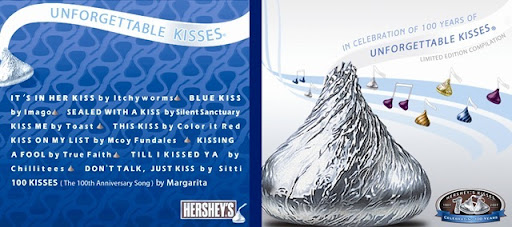
That’s what we hope to achieve with the release of UNFORGETTABLE KISSES, a CD compilation of songs that contain the word KISS in their titles, produced for Hershey’s Philippines in celebration of the 100th anniversary of Hershey’s Kisses. The CD has ten tracks: nine re-arranged versions of pop hits from the 50’s to the 90’s, remade by some of the country’s better-known bands; and a song specially written for the anniversary.
The songs are amazing! Just check out the line-up:
- It’s In Her Kiss (popularized by The Hollies, then by Cher and Vonda Sheppard) - by Itchyworms
- Blue Kiss (popularized by Jane Weidlin, formerly of The Go-Go’s) - by Imago
- Sealed With A Kiss (popularized by Chad and Jeremy) - by Silent Sanctuary
- This Kiss (popularized by Faith Hill) - by Color It Red
- Kiss Me (popularized by Sixpence None The Richer) - by Toasted
- Kiss On My List (popularized by Hall and Oates) - by Mcoy Fundales
- Kissing A Fool (popularized by George Michael, then by Michael Buble) - by True Faith
- Till I Kissed Ya (popularized by The Everly Brothers) - by Chillitees
- Don’t Talk, Just Kiss (popularized by Right Said Fred) - by Sitti
- 100 Kisses (The 100th Anniversary Song) - by Margarita
Listen to snippets of the songs at http://www.kisses100.com.ph. And smile.
The memory rush is about to start!
Happy Anniversary, Hershey’s Kisses!

 Posts
Posts


