via scribd.com
Toys R Us is using QR codes to promote more than 20 of its large outdoor items and is letting consumers visualize how the product would work and look in their own backyards.
Since many of the outdoor items are too large to display in-store, Toys R Us is using in-store signage that lets consumers scan the QR code of a product in which they are interested. According to the retailer, this is its largest QR code program to date.
“Customers are increasingly using their smartphones while shopping to find details on the products they are looking to purchase,” said Meghan Kennedy, a spokeswoman for Toys R Us, Wayne, NJ.
“With these QR codes, Toys R Us is providing customers with an engaging in-store experience that allows them to see these outdoor items, which are too large to display within our stores, in action,” she said.
Toysrus.com is the Web portal for Toys R Us Inc., one of the biggest toy retailers in the world. The company operates 1,550 stores, including 849 Toys R Us and Babies R Us stores in the United States and more than 700 international stores in 33 countries.
Toys in action
The QR code implementation is meant to help Toys R Us customers see the backyard toys in action.Consumers can scan the mobile bar code next to the product with their mobile device to view video footage or images of the item fully set up.
Additionally, many of the products have corresponding videos that showcase kids playing with the summer toys.
Many of the outdoor items featuring QR codes include trampolines from Bravo Sports, pools from Summer Escapes by Polypool and a variety of products from Step 2, such as sandboxes, slides, clubhouses and picnic tables.
Consumers can learn more about the products via the QR codes
“The display is prominently positioned in Toys R Us stores across the country for the summer months,” Ms. Kennedy said. “Customers can simply scan the QR code of the product they are interested in with their smartphone to view video footage or images of the item fully set up.
“Many of the products have corresponding videos that showcase kids playing with these fun summer toys,” she said.
Past initiatives
Last year, Toys R Us rolled out a virtual store that let consumers scan QR codes featured on billboards and shop the company’s 2011 Hot Toy List.On-the-go commuters and travelers in the New York metro area were encouraged to take part in the initiative.
Billboards located in John F. Kennedy International Airport, LaGuardia Airport and nearly 40 NJ Transit Stations feature the showcased items (see story).
QR codes are a hot commodity and the technology is helping marketers bridge the digital and traditional world.
“We continue to look for ways to enhance our mobile capabilities and provide a seamless shopping experience for our customers,” Ms. Kennedy said.
Final Take
Rimma Kats is associate editor on Mobile Commerce Daily, New York
Rimma Kats is associate editor on Mobile Commerce Daily and Mobile Marketer. Reach her at rimma@mobilemarketer.com.
Like this article? Sign up for a free subscription to Mobile Commerce Daily's must-read newsletters on mobile commerce. Click here!
Related content: None Found
Tags: Meghan Kennedy, mobile, mobile bar codes, mobile commerce, mobile marketing, mobile shopping, QR codes, Toys R Us
You can leave a response, or trackback from your own site.
Guinness wanted to get more people talking about the brand, so they gave local bars some new pint glasses. At first glance, the glasses looked like a regular pints- but bartenders and patrons learned that when they were filled with a Guinness, the glasses were actually printed with a QR code.
Created by BBDO NY, the QR code could only be scanned when a Guinness (or for argument’s sake, any dark beverage) was in the pint glass; regular beer didn’t create enough contrast, and when nothing was in the glass, the QR code just looked like a creatively etched design on the side of the cup.
When bar-goers scanned the QR code with their smartphones, the app shared the news to friends that they were enjoying a Guinness via twitter, foursquare, Facebook, and Instagram updates. Scanning the QR code even sent out the bar-goers’ locations– with the hope being that friends who saw the updates would join their pals at the bar for more Guinness drinking.
Answering the age-old question of what’s for dinner is an outdoor and mobile campaign by Allrecipes running in Los Angeles.
The "Fix Dinner" campaign uses pictures of the most popular local recipes in L.A. on Allrecipes.com during the month of May alongside a QR code.
Snapping that code with a smartphone will allow users to open the recipe and create a shopping list accessed via phone or the Allrecipes.com Dinner Spinner app.
Here’s a look at the top 10 recipes in L.A. for May:
1. Actually Delicious Turkey Burgers
2. Lime Chicken Soft Tacos
3. Grilled Salmon
4. Yummy Honey Chicken Kabobs
5. T’s Sweet Potato Fries
6. Grilled Corn on the Cob
7. Chicken Tikka Masala
8. California Grilled Veggie Sandwich
9. Simple BBQ Ribs
10. Asian Lettuce Wraps
The out-of-home campaign is Allrecipes’ first. The bus stop takeover is no coincidence: Allrecipes found that traffic (the online kind) to its site increases significantly at the end of each workday. Lisa Sharples, president of Allrecipes, devised the month-long campaign when she was standing at a bus stop after work, trying to decide what to feed her five children for dinner.
Allrecipes is currently tracking the number of recipes accessed by QR codes by location and recipe, for some recipes appear in more than one location.
A nationwide Scarborough research survey found that Business Frequent Flyers are 83 percent more likely than all American adults to be the first to try or buy new products and services. This custom study was commissioned by Clear Channel Airports (CCA) and conducted by consumer market research firm Scarborough. The survey results highlight the value to advertisers of targeting frequent travelers while they are in transit in airports.
The study included nearly 2,000 adult participants age 18 or older, and highlights the importance of airports in today’s busy multimedia world. Airports, a “high dwell-time environment,” deliver a captive audience and provide advertisers with a potential for strong returns on investment. In addition, according to the survey, approximately three in four Frequent Flyers and Business Frequent Flyers both notice airport advertising and take the time to actually read the message.
The national survey found that airports provide advertisers with a saturated audience of affluent, educated, tech-savvy travelers. The two key audience groups identified by the survey are Frequent Flyers (adults who have taken three or more round trip flights in the past year) and Business Frequent Flyers (adults who have taken three or more round trip business flights in the past year). Frequent Flyers account for more than 38 million adults, and Business Frequent account for more than 11 million adults, with an average household income of $125,000*. While Frequent Flyers and Business Frequent Flyers represent 36 percent of total flyers, they account for 70 percent of all airport impressions due to their more frequent travel.
The survey also showed that airports have a number of unique, high-visibility touch points — from security lines and concourses to connection hub, baggage claim and ground transportation areas — that allow advertisers to reach captive audiences in impactful ways. Clear Channel Airports is able to capitalize on these touch points through innovative programs that complement the unique airport space, such as compelling digital networks in gate hold areas, baggage carousel wraps and interactive experiential brand exhibits in the heavily trafficked concourses.
“This is an important study that highlights for companies of all sizes the significant buying power of frequent travelers,” says Toby Sturek, president, Clear Channel Airports, Allentown, Pa. “This study identifies a consumer demographic that spends time and money engaging with airport advertising and is very receptive to new products and services. The study is clear: Airports deliver high returns for advertisers.”
"The survey revealed that frequent business travelers are key market influencers. It is noteworthy that even with smartphones, iPads and many other mobile devices, frequent travelers are influenced by airport advertising," said Scott Willoth, senior vice president of analytics & insights for Scarborough. "This research is consistent with the unique value that Scarborough provides by focusing on customized studies that offer deep and actionable insights."
From user demographics to the impact geographic signposts have on advertising impressions, the survey demonstrated airports to be an ideal environment in which to engage an audience of affluent consumers. Among the key survey findings:
- Frequent Flyers are 56 percent more likely than the average adult to be the first to try or buy new products and services.
- Business Frequent Flyers are particularly hard to reach with advertising in more traditional media due to their busy lifestyles. For example, Business Frequent Travelers are 48 percent less likely to be heavily exposed to television compared to the average adult.
- Business Frequent Flyers are more than twice as likely to download a paid app in the past year, and are 128 percent more likely to scan a QR code with a smart phone, compared to the average adult. High dwell time and compelling, large-format inventory provide the perfect venue to reach tech savvy travelers with modern, interactive media campaigns.
The survey also focused on the amount of time air travelers spend in different areas of the airport, examining how that “captive audience time” helps drive advertising impressions and purchasing decisions. Notably:
- 89 percent of Frequent Flyers spend up to 30 minutes in airport security, meaning that fixed points of interest, such as security lines, are ripe for advertising.
- Half of Frequent Flyers spend 45 minutes or more in airport concourses after clearing security.
- Three out of every four travelers have purchased food and beverages from airport concessions.
- 73 percent of Business Frequent Flyers spend up to two hours in connecting airports during layovers, underscoring the importance of hub airports as advertisement investments.
- 89 percent of Business Frequent Flyers spend up to 30 minutes in baggage claim and 80 percent of Frequent Flyers have checked their luggage at least once during their last three personal trips.
The data in this press release is from a custom study conducted by Scarborough in fall 2011. Scarborough measured 1,983 adults nationwide in the areas of Frequent Flyers and Business Frequent Flyers.
*This data is from Scarborough USA+ release 2, 2011.
Since few shoppers can wait for Amazon to ship their gallon of milk, smartphone usage in grocery stores is an entirely different beast than in big-box and electronic retailers, where the "scan and scram" phenomenon of price comparing runs rampant.
Consumers aren't price checking against the Piggly Wiggly down the street the way they compare the values at Target vs. Best Buy, so mobile apps are popping up as tools for shoppers to find manufacturer deals and make lists as they trawl the supermarket aisles.
--> Food and medicine are the categories that see the least smartphone usage for research and shopping, according to an online survey from Omnicom Media Group and Microsoft. Phones are used more for shopping for entertainment products, restaurants and consumer electronics.Consumers are using mobile more in grocery.
"You see more scan-and-scram when you're buying a TV than when you're trying to save a $1 on Kleenex," said Daniel Blackburn, VP-mobile for interactive agency Rosetta's Level Studios.
Sixty-five percent of the 3,500 shoppers in five global markets wanted their cellphones to find in-store promotions, according to Omnicom's survey. Making shopping lists and finding items in stores are also top mobile priorities.
In recognition of this, last month, Catalina, the company that powers loyalty programs for 30,000 stores nationwide (including those back-of-receipt coupons), acquired mobile commerce company Modiv Mobile.
Modiv, now Catalina Mobile, is behind mobile apps in 110 of Ahold USA's Stop & Shop stores in Massachusetts, Rhode Island and Connecticut. Here's how it works: A shopper walks into the store, opens the store-branded app and receives offers based on their shopping history. To skip the line at checkout, shoppers can scan barcodes of items they put into the cart to buy the haul right on the phone. Catalina says the app will be available in 200 more Stop & Shops this summer.
The Ahold partnership predated Modiv's acquisition by Catalina, which operates in more than 85 U.S. chains, including Target, Kroger and Safeway, and distributes coupons for major packaged-goods brands. Catalina reaches 75% of U.S. households across 30,000 stores, said Todd Morris, the company's exec VP-brand development and marketing innovation.
Its focus remains on using mobile to change purchase behavior in stores, rather than warding off online grocers such as Fresh Direct. "Sure, I'll use Red Laser to compare prices on electronics, but no one's going to do that with a box of cereal," said Mr. Morris of the price-comparison app eBay acquired in 2010.
"The whole use case of scanning dozens of boxes of Cheerios to see which is cheaper is a little silly," said Dhana Pawar, director-mobile product management at Coupons.com, which updated its Grocery iQ mobile app this month.
Coupons.com, a behemoth in digital coupons that's raised $285 million in funding over the past several years, focuses on bringing packaged-goods brands into the list-making process with an app called Grocery iQ. In the first quarter, 71% of shoppers made their lists at home, according to the SymphonyIRI MarketPulse survey.
Shoppers create lists in the app by scanning barcodes or typing in entries, then the app organizes those items by aisle. The most recent update ports coupons into the search tool so that, say, a shopper may add one brand of yogurt to the list over another because Coupons.com offers 50¢ off. Coupons.com reports that Grocery iQ has "millions" of downloads and active users use it three to four times a week. It's also added brand advertising: Hormel has sponsored the meat and seafood tab in the app.
To redeem coupons from the app, users can email coupons to print at home or sync the app with their loyalty cards at participating stores, including Safeway, so savings are automatically deducted at checkout.
You want to start a business. So you need a plan, right? No. Not really.
As part of the research for a book I'm co-authoring — Heart, Smarts, Guts, and Luck, due out in August from HBR Press — my colleagues and I interviewed and surveyed hundreds of successful entrepreneurs around the globe to better understand what it takes to be an entrepreneur and build a really great business. One of our most striking findings was that of the entrepreneurs we surveyed who had a successful exit (that is, an IPO or sale to another firm), about 70% did NOT start with a business plan.
Instead, their business journeys originated in a different place, a place we call the Heart. They were conceived not with a document but with a feeling and doing for an authentic vision. Clarity of purpose and passion ruled the day with less time spent writing about an idea and more time spent just doing it.
It's not that all planning is bad. It's that efforts to write the "perfect" business plan usually lead to being precisely incorrect rather than approximately correct. One problem is that the content that most people focus on in business plans has little to do with the reality that will actually emerge. Many start-up plans emphasize some gigantic potential market and how getting just the smallest sliver of it will make them and investors rich. A colleague of mine offers the hypothetical example of selling a bar of soap for a dollar every month to just 0.5% percent of the people in China. It's nearly a $100M business! Good luck making it happen, though.
At a business's inception, resources are limited, and the best content for a business plan is real-world data based on testing aspects of the concept. These experiments need not be complex. You want simple, iterative tests that are easily measurable and let you know whether you are winning or not.
It's not just start-ups. The strategic architecture of any business should incorporate facts from real world testing to allow one to adjust course as necessary. This is what Henry Mintzberg, a seminal figure in competitive strategy theory, once described as "emergent" or "evolutionary" strategy. My business partner Mats Lederhausen (formerly global head of strategy for McDonald's as well as former Executive Chairman of Chipotle) has his own saying for it: think big, start small, then scale or fail fast.
So don't worry too much about a business plan. But to guide your thinking, improve a pitch to prospective investors, or better align your teams, consider these design points:
1. Identify and clearly articulate your Heart and purpose. Whether you want to call it vision, Heart, purpose or calling, be very clear on the why of a business — the bigger goal at hand.
2. The team is more important than any idea or plan. The top three priorities should be people, followed by people, and then people.
3. Think big, start small, then scale or fail fast. Per Lederhausen's advice, set the right first "start small" milestone; it will usually involve seeing people's willingness to buy or at least try your product.
4. Focus on a well-defined market sub-segment or niche. At least to start, think of where you can potentially be the best. This strategy is almost always more successful than being just another player in a massive market.
5. Understand your business model. How you will make money is more important than pages of Excel showing financials that are simply too hard to predict at this early stage anyway. Understand instead the basic way you will make money - is it through transactions, advertising, subscriptions, etc?
There appears to be a perennial market for how-to classes, books, and templates that promise almost "color by number" instructions for populating business plans. While aspects of those tools are helpful for a structured approach, they are more likely to mislead because of their emphasis on completing the plan of a business before uncovering its soul and demonstrating whether others connect with it. People feel a sense of accomplishment upon completing their plan, but what does that plan really get them? Filling worksheets can never replace zeroing in on the passion and purpose of your business. That Heart has to be there day one. The most researched business plan holds little value without a genuine Heart behind the idea and the Guts to just get it going.
“Content is king” has been a long-lived mantra of media. And in the 1990s and early 2000s, it was true.
But over the last several years, the Internet has upheaved the aphorism.
It used to be that media was linear. And in that world, content and distribution were married. The HBO channel had HBO content. A New York Times subscription bought you New York Times content. And Vogue and Cosmopolitan each month delivered exclusive and proprietary content from … Vogue and Cosmopolitan.
Until the Internet came along. In every single one of the varied businesses the Internet has touched — from commerce to media to communications to payments — there has been one common impact: disaggregation.
Content and distribution have parted
In the case of the hundreds-of-years-old media business, the Internet has fundamentally separated content from distribution.
Today I can watch hundreds of South Park and Jon Stewart clips, all without a cable box — on my Apple TV, my Android phone, or YouTube on my desktop.
But wait, South Park and Jon Stewart? Content is king, you say. It’s now even more free to reign, unfettered by distribution channels!
No; because content is no longer enough. Content has always been a means to an end. And the end has always been audience.
Content isn’t the goal. Audience is.
When it comes to the business of media, there’s no question: advertisers don’t pay to reach content. They pay to reach an audience.
What’s the first item in every brief from every advertiser? It’s not Target Content, it’s Target Audience.
Media has been slow to adjust to this new dynamic. Companies have sunk billions into content management systems — using CMS as the cornerstone of their modernization — under the impression that they traffic in content.
But they don’t. They traffic in audience. And how much have they spent on audience development systems? Not much, if any at all.
Now that distribution of content to audience is no longer linear, distribution decisions are suddenly more complicated. And, at the same time, they are immensely more important — and more dynamic — to create the impact media companies are looking for: drawing an audience! Social distribution can outperform search, if you use it wisely. Day-parting your postings can boost post performance by 100 percent or more. Packaging can triple the effectiveness of content in reaching an audience.
And yet, few in media have even begun to optimize these decisions.
Who’s your Chief Audience Officer?
Distribution decisions are just as important as content decisions in building and serving an audience, and yet they are being largely ignored. Everyone has an Editor-In-Chief or a Chief Creative Officer. But how many have a Distributor-In-Chief? Or a Chief Audience Officer? A Head of Digital Programming?
The myopic focus on content over distribution is widespread, and it’s a bad business decision. It ignores a critical access of leverage, and one of competitive advantage.
The smartest media companies will do three things to take control of their digital opportunity:
- Put someone in charge of audience development.
Give them latitude to think about the interplay between distribution and content, so that they can marry the two. Like a head of programming for a cable network, they should be tasked to realize the full potential of your digital channels. They should support the delivery of your content, and they should also provide back pressure to your content creators. Don’t merge it into your editorial jobs — that’s too precarious. Make it its own discipline.- Adopt an audience development strategy.
There are three basic components you have to master: insights (know your audience segments, and what each one will like); channel selection (identify the highest value distribution outlets for your brand, whether it’s search, social, YouTube, Hulu, or your own channels); and optimization (use data to create a feedback loop and tune your content, packaging, and timing to what works for your audience).- Systematize it.
You have sunk millions into content management systems. But how much have you spent on your most monetizable asset, your audience? You should be as systematic in audience development as you are in content creation, if not more so. Whether it’s with established processes or dedicated algorithms, make audience development a competitive advantage. Get so good at it that you truly know how to maximize every piece of content you create — and multiply your ROI. Use technology for what it does best: Systematize your advantages over your competitors.With the rise of new distribution platforms like Facebook, YouTube and Hulu, there’s no question that the next generation of digital media is as much about distribution as it is about content. Media companies that orient their organizations to prize audience development above all (with distribution as a key component) will catch the upside of these tectonic shifts. And they will be the ones that survive and thrive in the digital age. After all, audience is the ruler of media companies’ fortunes.
This article by Ben Elowitz (@elowitz) is an exclusive selection from his Media Success newsletter for digital media leaders. Elowitz is the co-founder and CEO of next-generation media company Wetpaint and the author of the Digital Quarters blog about the future of digital media. Prior to Wetpaint, Elowitz co-founded Blue Nile (NILE).
Rand McNally maps out mobile strategy with QR codes
By Chantal Tode
April 25, 2012
Road atlas is mobilized via QR codes and an app
Rand McNally is recruiting mobile to enhance the functionality and drive engagement for its latest road atlas via QR codes and a new mobile application.
To meet the needs of the increasingly connected car traveler, the new edition of the Rand McNally Road Atlas includes QR codes on several pages, enabling readers to access additional content such as suggested road trips. There is also a new smartphone app called Best of the Road that enables readers to share reviews on specific destinations by linking to the online Best of the Road community.
“Mobile allows the Atlas to be better used as a trip-planning device, allowing for up to the minute information to be communicated,” said Jennifer Cavallo, product manager for the Road Atlas line at Rand McNally, Skokie, IL.
“While on the road, mobile content can be helpful for discovering close-by and unique stops, emergency services, and other information on the road ahead,” she said. “We also plan to use QR codes on our state maps, beginning this summer.”
An evolving strategy
The new app enables users to participate in Rand McNally’s Best of the Road program, which is taking place this summer, by sharing destination reviews and place nominations for the best small town. It is currently available for the iPhone and will soon also be available for Android smartphones.Users of the app can read reviews of the best small towns and view photos, blogs and bios from bestoftheroad.com. They can also find nearby points of interest, watch videos from the 2011 Best of the Road Rally and browse over 250 road trips.
Best of the Road is a community of road travelers reviewing the best stops on America’s roads, nominating the best small towns and discussing points of interest along the way.
The QR codes provide instant access to travel videos and state-by-state overviews with suggested road trips. Users can also scan a QR in the road atlas to access the Best of the Road user review app.
Rand McNally has been using QR codes in its road atlas for several years and continues to evolve the strategy.
“The QR codes allow us to easily direct the user to rich content such as videos, specific editorial, and up-to-the minute destination information,” Ms. Cavallo said.
Essential planning tool
According to the publisher, the QR codes on the front cover of the atlas receive the most scans. QR codes can also be found on the coupons page, the U.S. overview map and all state map pages.Having QR codes enables the publisher to update offers on the coupon pages and tailor information to a specific place.
Travel-related brands such as Rand McNally are increasingly embracing mobile because of the convenience it offers busy travelers who are looking for a restaurant, hotel or other destination when they are on they are traveling.
“We continue to evolve the integration of the atlas to other media in order to increase the relevance to the end user, and make the Atlas an even more essential planning tool,” Ms. Cavallo said.
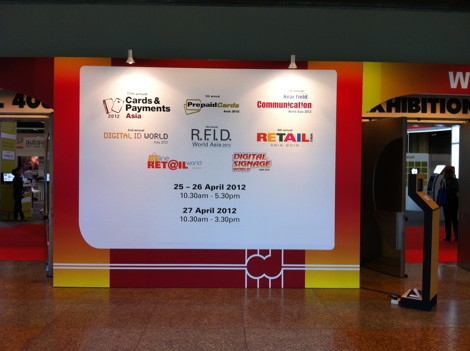
Digital Signage World Asia 2012 seems much smaller now than its last staging almost 2 years ago.
Exhibition-wise at least it seems that the global heavy-hitters have shied away, leaving their integrators to press the flesh – HP, Microsoft were there by proxy and it looked like only Intel was inside – literally.
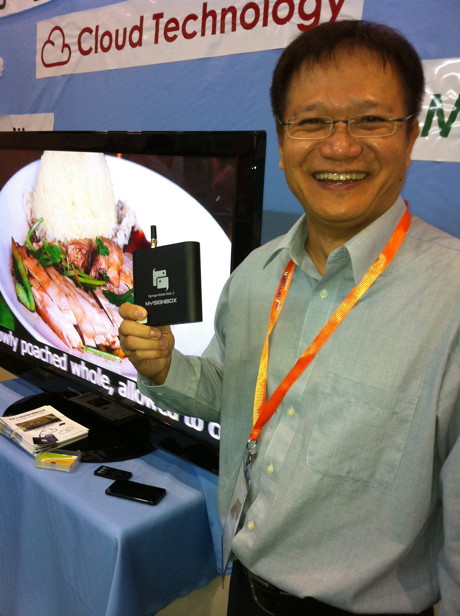
Still, there were some reasons to smile. Korea’s D4 showed off its transparent screen, which works to virtually contextualize tangible objects on display behind it – a couple of people have already emailed us to say this is the likely star of the exhibit space, EdMalaysia’s MySignBox boldly announced a bid to break into the US market with its Microsoft Cloud-based ‘DIY’ system that regionally taps the Asian entrepreneurial bent by offering a player for ‘emerging’ retailers and their chains.
Co-founder Tumin Chook (shown to the right here with his device) thinks the DIY market in the US is ripe for his solution.
Day 1 of the exhibition was understandably heavily retail-flavored, considering that the event was co-located with retail, cards and payments events. A good sign perhaps that applications in Asia’s Digital Signage space, seem at pace with its technologies.
The conference proper starts tomorrow.
This entry was posted on Wednesday, April 25th, 2012 at 07:34 @357 and is filed under DailyDOOH Update. You can follow any responses to this entry through the RSS 2.0 feed. You can leave a response, or trackback from your own site.
Digital Signage World Asia 2012 seems much smaller now than its last staging almost 2 years ago. Exhibition-wise at least it seems that the global heavy-hitters have shied away, leaving their integrators to press the flesh – HP, Microsoft were there by proxy and it looked like only Intel was inside – literally.
Still, there were some reasons to smile. Korea’s D4 showed off its transparent screen, which works to virtually contextualize tangible objects on display behind it.Malaysia’s MySignBox boldly announced a bid to break into the US market with its Microsoft Cloud-based ‘DIY’ system that regionally taps the Asian entrepreneurial bent by offering a player for ‘emerging’ retailers and their chains.
Co-founder Tumin Chook thinks the DIY market in the US is ripe for his devices.
Day 1 of the exhibition was understandably heavily retail-flavored, considering that the event was co-located with retail, cards and payments events. A good sign perhaps that applications in Asia’s Digital Signage space, seem at pace with its technologies.
The conference proper starts tomorrow.
@mysignbox are on booth 4010
This entry was posted on Wednesday, April 25th, 2012 at 07:34 @357 and is filed under DailyDOOH Update. You can follow any responses to this entry through the RSS 2.0 feed. You can leave a response, or trackback from your own site.
Schumpeter
How to make a megaflop
Three simple rules to ensure humiliating failure
Mar 31st 2012 | from the print edition

MEL BROOKS’S classic comedy, “The Producers”, tells of two crooks who try to cheat their investors by producing a sure-fire theatrical flop. Alas, the production is so ridiculous—a celebration of “the true Hitler…the Hitler with a song in his heart” performed by semi-deranged actors—that the audience loves it.
“John Carter”, Disney’s latest offering, sounds almost as ridiculous. A veteran of the American civil war is somehow transported to Mars, forced to wear a loin cloth and confronted with a succession of monsters. But the other two elements of the equation are reversed. Disney hired one of its most reliable hit-makers, Andrew Stanton (of “Wall-E” and “Finding Nemo” fame), to write and direct the $300m project in the hope of producing another megafranchise. But “John Carter” looks set to be a megaflop, down there with “Heaven’s Gate”, “Ishtar” and “Cutthroat Island”. The film made a pathetic $30m during its opening weekend in America; the studio has taken a $200m write-down.
In this sectionRelated topicsFlops are part of business life. They are most conspicuous in the entertainment business, where public taste is hard to predict. But you can find them in any industry that depends on launching products and generating buzz. The number of flops may well be on the increase: seven of Hollywood’s ten biggest flops, adjusted for inflation, have been released since 2000 (only last year Walt Disney produced another red-planet related stinker in the form of “Mars Needs Moms”). There are more products competing for people’s attention than ever before, and on more media. Businesses have less time to break through the noise; big films routinely open on 3,000 screens, but quickly scale down if seats are unfilled. More businesses are becoming like Hollywood: to launch a product they must spend a fortune on marketing, which may all be wasted.
Is there a secret sauce for failure? A guaranteed way for the modern equivalent of Mel Brooks’s producers to produce a megaflop? The answer is a qualified “yes”. There are three principles that have proven particularly effective over the years.
First: slaughter a sacred cow. The most spectacular slaughter, of course, was Coca-Cola’s decision to kill off the drink that gave it life. Coca-Cola was arguably the most beloved American brand ever—“the sublimated essence of all that America stands for,” in the words of one journalist, “a decent thing, honestly made.” But in 1985 the company decided to replace “the real thing” with a new Coke, ostensibly on the grounds that it had discovered a new, tastier “secret formula” but in reality because it was worried about Pepsi’s growing market share.
Coca-Cola quickly discovered that it was merely the custodian of the brand, rather than its owner. Angry Coke-drinkers accused the company of doing the equivalent of redesigning the American flag or blasting Teddy Roosevelt off Mount Rushmore. One group complained that the company was violating their freedom of choice. (“We went to war with Japan over that freedom,” they sputtered.) Less than three months after their foolish decision, Coke’s bosses grovelled to customers and reintroduced classic Coke.
Second: mix oil and water. Theatrical impresarios are the masters of this—over the years they have tried, unwisely, to turn Hamlet, Lolita and Ernest Hemingway’s drunken last days into musicals. ABC once added song and dance to an otherwise formulaic cop drama, “Cop Rock”. Other industries have made similar mistakes, albeit less noisily. McDonald’s spent $100m launching a burger for upmarket customers, the Arch Deluxe. The snag was: who goes to McDonald’s for upmarket food? Ford once produced a pickup truck for the luxury market. Same problem. Bengay tried to stretch its heat-rub brand into the aspirin market. Ouch. Colgate made TV dinners; you could eat one and then brush your teeth with Colgate toothpaste. Few found this appetising.
Third: produce a genuinely awful product. The Ford Pinto had a nasty habit of catching fire if it was rear-ended (the petrol tank was behind the rear axle). Microsoft’s Vista operating system appeared to be incompatible with every other programme. Worst of all was the former Yugoslavia’s Yugo car. It enjoyed such a successful launch that hundreds bought it sight unseen. The trouble began when they tried to drive it. Consumer Reports slammed it: the bonnet (hood to Americans) came loose, the rear window-washer quit, the ignition switch broke and the brakes squealed, the review complained. Motor Trend reported that it even broke down during a road test. “What comes with every Yugo’s owner’s manual?” went one of the thousands of jokes inspired by the car. Answer: “a bus schedule”.
Fear of flopping
Still, the surest way to guarantee failure in the long term is to be so paralysed by the fear of it that you don’t try anything new. The line that separates a hit from a flop is thin. Companies sometimes have to slaughter sacred cows to escape obsolescence: IBM only recovered from its death spiral when it abandoned its focus on building hardware. Some of the most successful products are the result of mixing oil and water—most obviously, phones with computers and entertainment systems.
What looks like a flop can flip into a success. After New Coke fizzled, sales of the original version rebounded, lifting the firm’s stock price and reviving what had been a fading brand. Pringles (the stackable crisps, not the alarming jumpers worn by golfers) started life as one of Procter & Gamble’s greatest flops. They are now munched everywhere, including over this kybard#. This is not to say that readers should put aside their doubts and spend good money watching a civil-war veteran battling monsters on Mars. But the existence of flops such as “John Carter” is perverse proof that the Walt Disney Company is doing something right.
from the print edition | Business
Most Filipinos have no bank accounts—BSP survey
By: Michelle V. Remo
Philippine Daily Inquirer11:49 pm | Wednesday, April 18th, 2012 Posted by clopez-->share28
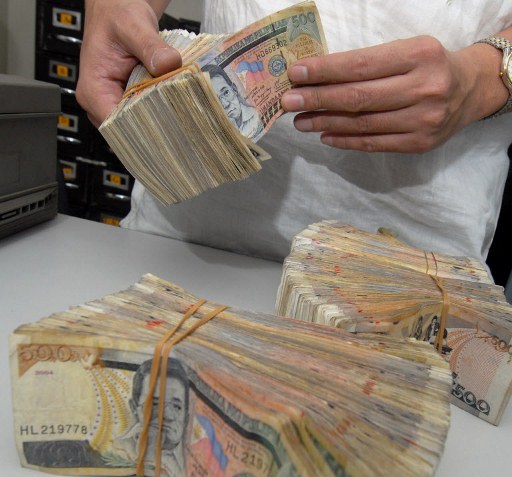
A bank teller prepares stacks of P500 denomination for the bank’s automated cash dispenser in this file photo. About 8 of 10 heads of Filipino households do not have any bank accounts because they do not have enough money to deposit, according to a survey by the Philippine central bank. AFP PHOTO/ROMEO GACAD
About 8 of 10 heads of Filipino households do not have any bank accounts, and most do not have enough cash saved up for emergencies.
These are some of the highlights of the first Consumer Finance Survey (CFS) conducted by the Bangko Sentral ng Pilipinas. Monetary officials said the results of the survey underscored the pressing need for the banking sector to reach out to more Filipino consumers and teach them the value of saving.
Based on the survey, most respondents who said their families did not have any savings accounts also saw no need to apply for any type of bank account because they would not have enough money to deposit. Other reasons cited were the high amount of minimum deposit balance required by banks and the aversion of most respondents in dealing with banks.
According to survey, about 4 of 10 households do not have any cash on hand to be used in case of emergency, while 6 of 10 households have very little cash to spare. Average cash on hand of Filipino families that may be used for emergencies stand at only P1,681.
These results may be traced partly to insufficiency of income. Also, lack of access to banks and the high tendency of Filipinos to spend—rather than save or invest—greatly influenced the results of the survey, the central bank said.
BSP Governor Amando Tetangco Jr. said in a press conference Wednesday that the survey revealed the need for greater effort “towards a more inclusive financial system,” where more people would have access to bank products and services, such as deposits and loans.
Such an effort is necessary, Tetangco said, if the government hopes to reduce poverty incidence.
He pointed out that the public’s savings are what the banking sector uses to extend loans to fund job-generating investments. Moreover, loans granted to microenterprises serve to lift the income of most poor people.
Tetangco said results of the survey also raised the need for tighter monitoring of financial transactions of consumers outside the formal banking sector.
The survey showed that some Filipinos are inclined to deal with informal moneylenders, which may include loan sharks, to finance their needs. One of 10 respondents said they have dealt with moneylenders.
“There is a need to look into shadow banking transactions,” Tetangco said.
BSP Assistant Governor Ma. Cyd Tuaño-Amador said that currently, the government has no sufficient resources to regulate individual moneylenders. She said, however, that what the BSP can do at the moment is to strengthen its financial literacy campaign by making people aware of the risks in dealing with informal lenders.
“Education of the public may help a lot in consumer protection,” Amador said.
Another interesting result of the survey is that 2 of 10 Filipino households depend solely or partly on remittances to support their expenditure requirements, indicating the importance of overseas Filipino workers in financially supporting households in the Philippines.
Moreover, 7 of 10 Filipino households are not risk takers, prefering to rely on fixed income rather than invest in businesses.
The survey, which took a few years to complete, covered 10,520 households nationwide. Data was collected from November 2009 to January 2010.
We Recommend
Recent Stories:
- Most Filipinos have no bank accounts—BSP survey
- Bloomberry to hold $200M equity offering
- Mining can help widen PH economic base, says CMP
- Consunji group buys 5.3% of Atlas Mining
- Samar infra project deal up for bidding
- East West Bank IPO priced at P18.50 a share
- Measures to solve Mindanao power problems proposed
- Kuya Money: When finances meet wellness
- Globe sets aside $700M for network upgrade
- Government urged to create ‘disaster-proof’ towns, cities
Complete stories on our Digital Edition newsstand for tablets, netbooks and mobile phones; 14-issue free trial. About to step out? Get breaking alerts on your mobile.phone. Text ON INQ BREAKING to 4467, for Globe, Smart and Sun subscribers in the Philippines.
Tags: Bangko Sentral ng Pilipinas , bank accounts , Filipinos , Philippines , survey
- Home
- >> News
- >> Software and technology
Top 10 QR code campaigns of Q1
By Rimma Kats
April 18, 2012
Taco Bell taps QR codes to drive engagement
Nowadays there is a love/hate relationship with QR codes. However, although many are against mobile bar codes, brands such as Starbucks, Kraft and Taco Bell are proving them to be essential to targeting new and existing consumers.
Over the past year, QR codes have gained momentum. Mobile bar codes are constantly being seen on billboards, bus shelters and product packaging to not only drive user engagement, but sales as well.
Here are the top 10 QR code campaigns of the first quarter, in alphabetical order.
Bath & Body Works
Earlier this year, personal care retailer Bath & Body Works used mobile bar codes to strengthen its social media strategy.More brands are using mobile to ramp up their social efforts. For this campaign, Bath & Body works sent out direct mail pieces that promoted its line of fragrance products that tied in with an in-store promotion.
When consumers scanned the mobile bar code they were directed to Bath & Body Works’ Facebook page where they could engage with other fans, as well as learn more about the company’s new products.
By placing QR codes on its direct mail pieces, Bath & Body works was able to engage its existing customer base.
There was also a prominent call-to-action on the direct mail piece that encouraged users to connect with the brand on Facebook by scanning the QR code.
A campaign such as this is a great way to continue a consumer relationship, beyond just a simple direct piece.
Bath & Body Works was able to keep the conversation going using mobile.
Chili’s
Chili’s Grill & Bar is no stranger to mobile.
The company is proving that mobile bar codes are core part of its marketing strategy by placing them on menus to advertise new products.
Chili’s has placed QR codes at more than 800 corporate-owned restaurants in the United States. The company is also experimenting with mobile bar codes on its children’s menus.
The Chili’s QR code campaign aimed to promote healthier living. The mobile bar codes linked to seven new healthy Chili’s menu items.
Consumers were encouraged to scan the mobile bar codes to view nutritional information and learn more about the dishes.
Coca-Cola/7-Eleven
Coca-Cola’s Powerade partnered with 7-Eleven to put QR codes the Big Gulp cups.The campaign let March Madness basketball fans view exclusive video content.
Each of the four collectible cups featured a mobile bar code that linked to Powerade’s mobile site where CBS Sports Analyst, Greg Anthony hosted a brief video a featured big play.
The mobile bar code campaign was a limited-time initiative.
Additionally, the video content was exclusive to 7-Eleven, compliments of Powerade.
The campaign was a great way for 7-Eleven to engage consumers in-store. Powerade also enticed them to scan the mobile bar code to view exclusive content.
Duane Reade
New York drugstore Duane Reade took an innovative route with its QR code campaign.The company placed mobile bar codes on its store windows to drive social media impressions and foot traffic.
The Duane Reade QR codes could clearly be seen when consumers passed the store location. The “Get Social with Duane Reade” campaign was part of Duane Reade’s major digital push in 2012.
Duane Reade also heavily integrated social into its mobile bar code campaign by placing Facebook, Twitter, foursquare and YouTube icons right next to the QR code.
Placing mobile bar codes on store windows is a great way to stop consumers in their tracks and let them engage with the brand.
Additionally, by adding social aspects, users are able to stay in touch with Duane Reade no matter if they are using Facebook, Twitter, foursquare or Youtube to do so.
Johnny Rockets
Unlike many companies who use QR codes to drive in-store traffic, sales or even their social efforts, Johnny Rockets used the technology to builds its email database.The international restaurant chain placed QR codes on signage throughout its locations to encourage consumers to join its Rocket e-club and receive local updates and deals.
The initiative was a smart move for the company in many ways.
For example, when consumers were sitting in a booth in the restaurant and waiting for their meal, there was a sign on their table that featured a QR code and encouraged them to scan it to learn more about how they can sign up for deals.
When users scanned the mobile bar code they were redirected to a mobile landing page where they could sign up to receive special offers and featured promotions.
Consumers were asked to enter their email address, full name, address, city, state, ZIP code, birthday and which Johnny Rockets location they frequent most.
In addition to QR codes, Johnny Rockets also used SMS to build its database by having consumers text the keyword ROCKETS000 to the short code 99158.
KFC
KFC was out of the mobile scene for a while, but when it came down to promoting its new Classic Pot Pie, the fast food giant went full force.In addition to running mobile ads that promoted the new product, KFC also placed QR codes that let consumers vie for a chance to win hundreds of prizes given away every hour.
Prizes included a trip to Las Vegas, KFC chicken for a year, Dr. Pepper for a year or a one year premium Slacker Personal Radio subscription.
When users scanned the QR code they were redirected to a mobile landing page where they could enter the code featured on their soft drink cup.
Consumers also had the option of sharing the sweepstakes with friends and family through Facebook and Twitter. If they shared it, they received another free code.
The campaign was innovative because instead of placing the QR codes on in-store signage, KFC put them on its soft drink cups where more eyes would see it.
Additionally, by linking to a sweepstakes consumers are more inclined to scan the mobile bar code.
Kraft
As part of its multichannel marketing campaign earlier this year to promote the company’s line of cheeses, Kraft decided to add a QR code component.Kraft put mobile bar codes on five different cheese products and announced plans that it would place QR codes on more products in the future.
Each product has a unique mobile bar code. When consumers scanned the QR code, they were taken to a mobile landing page where they could view a recipe about the particular cheese product.
In addition to placing mobile bar codes on its packaging, the company is also placing QR codes on print advertisements.
The campaign was a smart move for Kraft because it featured recipes that consumers could make using the company’s products.
By using mobile, Kraft was able to engage consumers and have them coming back to buy more of its products to use on future recipes.
Samuel Adams
Samuel Adams placed QR codes on where its targeted customers would see it best – bar coasters.Samuel Adams parent company Boston Beer worked with Wall Printing Co. to create interactive four-panel coasters that folded in a series of directions to reveal the different panels.
A QR code was featured prominently on one of the panels and encouraged bar customers to scan it for a special offer.
According to the company, the coasters were meant to make people notice the Samuel Adams brand and the special offer.
The campaign was also a great way for Samuel Adams to learn more about consumers by having them enter their name, email address, mailing address and date of birth after they scanned the QR code to receive a coupon.
Starbucks
When it comes to mobile, Starbucks is always ahead of the game.When it came to promote its new coffee roasts, Starbucks used QR codes.
The coffee giant let consumers find their favorite roast via a new campaign. Starbucks handed out bookmark fliers throughout its in-store locations to promote its Blonde, Medium and Dark coffee roasts.
In addition to including a coupon on the bookmark flyer, there was also a mobile bar code that let consumers vote for their favorite roast and watch a video to learn more about the company’s coffee.
The bookmark fliers were a smart move because they not only featured a coupon that consumers were able to redeem, but the QR code was also prominently included and there were directions that let consumers know that they could scan the mobile bar code to learn more about the new products.
Taco Bell/Doritos
Taco Bell has been heavily using QR codes in the past year.To promote its new Doritos Locos Tacos product, the fast food giant placed mobile bar codes on its packaging, as well as ran targeted mobile ads.
Music played a key role in the Doritos Locos Tacos campaign.
Taco Bell integrated its brand and Doritos Locos Tacos at the Feed the Beat Concert Series.
Those that did not attend the show could still view performances by scanning the QR codes featured on the Doritos Locos Tacos holsters, which led users to exclusive video content showcasing performances from the Hype Hotel.
A new performance was featured each week.
By placing the QR codes on its packaging, consumers were able to clearly see the call-to-action and scan the mobile bar code to engage with the brand.
Final Take
Rimma Kats is associate editor on Mobile Marketer, New YorkAssociate Editor Rimma Kats covers media, television, research and social networks. Reach her at rimma@mobilemarketer.com.
Related content: Software and technology, Taco Bell, Doritos, Samuel Adams, Starbucks, Chilis, Kraft, Bath and Body Works, KFC, Duane Reade, Coca Cola, 7 Eleven, Johnny Rockets, QR codes, mobile bar codes, mobile marketing, mobile
- Trackback url: http://www.mobilemarketer.com/cms/trackback/12604-1
- Tweet this |
Follow us on Twitter

 Posts
All Comments
Posts
All Comments